Which smart home sensors actually make a home safer
Smoke, gas, carbon monoxide, leak and door sensors, useful scenarios, the limits of a smart home and how it compares with a burglar alarm.
5 min read
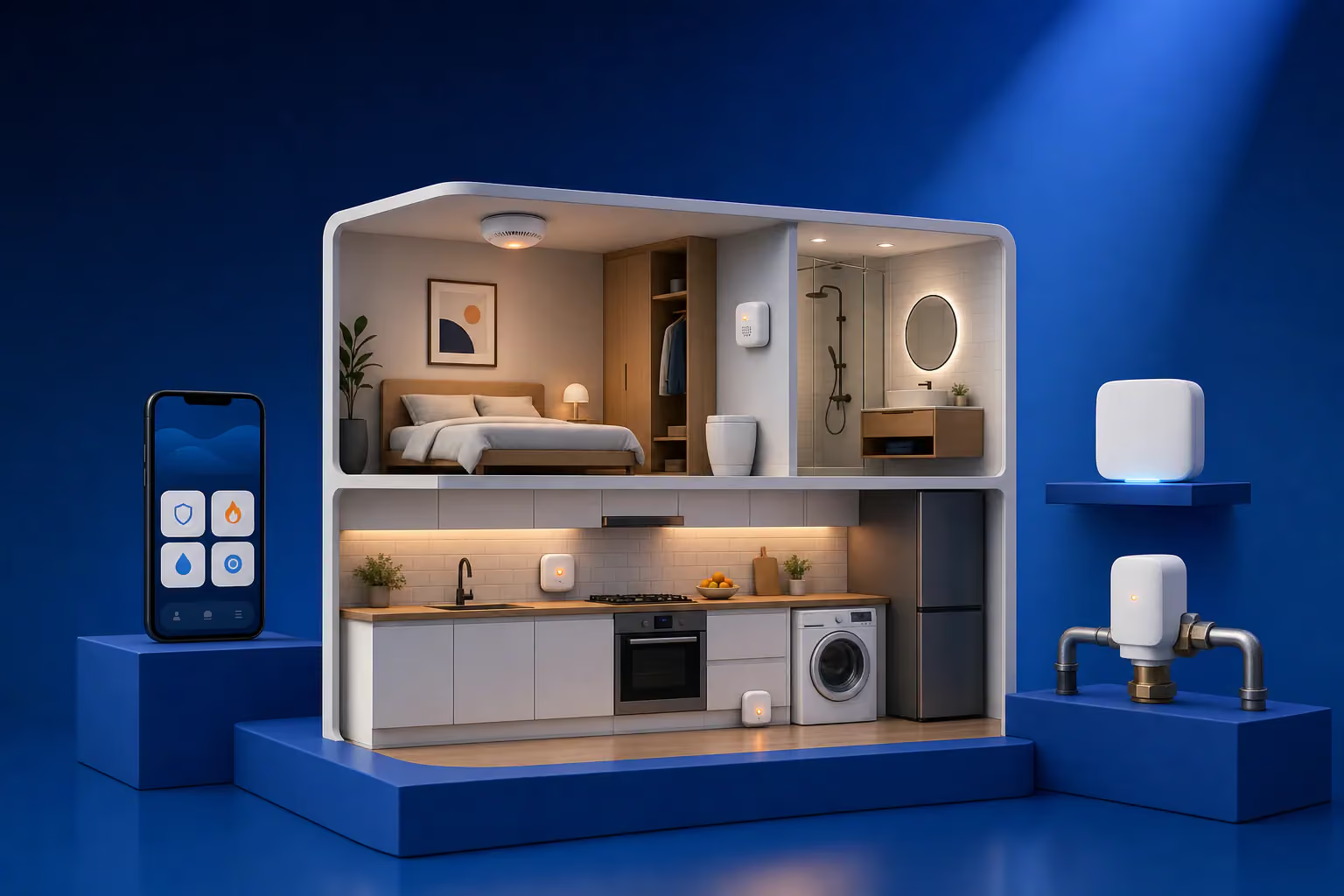
Of all smart home devices, the ones that do most for safety are sensors that warn you while a problem can still be stopped: smoke, natural gas, carbon monoxide, water leak, and door and window sensors. Cameras, smart plugs and scenarios are useful, but they work together with these sensors. A smart home and home security fit well together as long as you remember the limits: the system depends on the internet and electricity, and nobody comes out when it raises an alarm.
Sensors to install first
| Sensor | Protects against | Where it goes | What the scenario does |
|---|---|---|---|
| Smoke | Fire, especially at night | Bedrooms, hallway, living room, one per floor | Sounds the siren, turns on lights, sends an alert |
| Carbon monoxide | Poisoning from a faulty boiler, fireplace or water heater | Near the boiler and in bedrooms, as the maker instructs | Siren and an alert to every family member |
| Natural gas | A leak in the kitchen or at the boiler | Methane is lighter than air, so the sensor goes near the ceiling. For bottled propane, which is heavier than air, it goes near the floor | Shuts off the gas with a solenoid valve |
| Water leak | Flooding your home and the neighbours below | Under the washing machine, dishwasher, water heater and sink | Shuts off the water with a motorised valve |
| Door and window | Break-ins, a window left open | Front door, balcony, ground-floor windows | Alert and siren when armed |
| Panic button | An elderly person needing help | By the bed, in the bathroom | A call or message to relatives |
Leak and gas sensors only help if a scenario shuts off the water or gas. Without a motorised valve, you get a flood alert at work and can do nothing about it. Models are in the catalog under smart sensors, smoke alarms, gas alarms and carbon monoxide alarms.
Scenarios that save you worry
- An "Away" button arms the door sensors and switches off the smart plug for the iron or heater.
- Lights on a schedule in different rooms while you are on holiday make the home look occupied.
- When a smoke sensor triggers at night, the hallway light comes on so the way out is visible.
- If the front door opens while the whole family is away, you get an alert with a snapshot from the door camera.
The limits of a smart home
Most systems send alerts through the maker's cloud service. If the internet is down, the alert does not arrive. Hubs with local scenarios keep shutting off water and gas without the internet, so choose one of those for safety.
The hub and router run from the mains. In a power cut, battery sensors keep working, but nothing is left to pass on the alarm. A small UPS for the hub and router covers a few hours.
An app notification is easy to miss when the phone is on silent. For fire and gas, a loud siren in the home matters more than a message. Finally, for sensors that protect life, choose certified models: EN 14604 for smoke alarms and EN 50291 for carbon monoxide alarms.
Smart home or burglar alarm
| Parameter | Smart home | Burglar alarm |
|---|---|---|
| Communication | Wi-Fi or Zigbee through a hub, alerts through the cloud | Its own panel with GSM and internet |
| Power | Hub from the mains, UPS optional | Panel with a built-in battery |
| Tamper protection | Rare | Tamper switches on housings, radio jamming detection |
| Alarm response | An alert to the owner | To the owner and, optionally, a monitoring station |
| Strength | Household risks: leaks, gas, appliances left on | Protection against break-ins |
We often install both together: the burglar alarm handles intrusion, and smart sensors handle water, gas and everyday risks. Our article on choosing a burglar alarm for an apartment covers alarms in detail, and how to choose home security cameras covers cameras.
One ecosystem instead of five apps
Sensors from different makers often need different apps, and you cannot build a scenario across them. Choose one ecosystem and one hub. Zigbee sensors work through the hub and save battery, while Wi-Fi sensors connect to the router directly but drain faster. For battery sensors, Zigbee is usually the better fit.
How we build a smart home with safety first
LAGI chooses the ecosystem, fits the sensors and the motorised water and gas valves, sets up scenarios and alerts for each family member, and connects the hub and router to a UPS. Site surveys in Tbilisi are free. The smart home installation page describes the work in more detail. To find out the cost for your home, send a quote request.
Frequently asked questions
Does a smart home work without internet?
Partly. A hub with local scenarios keeps shutting off water and gas when sensors trigger, and it still sounds the siren. Phone alerts and remote control from the app stop working without the internet. If safety comes first for you, choose a hub that works locally and keep a siren in the home.
Can a smart home replace a burglar alarm?
For protection against break-ins, a professional alarm is better. It has its own battery, a GSM channel, tamper and jamming protection, and it can pass the alarm to a security company. A smart home is stronger on household risks, so the two are usually installed together and run from one app.
Where should a gas sensor go?
It depends on the gas. Natural gas, methane, is lighter than air and collects high up, so the sensor goes near the ceiling by the cooker or boiler. Bottled propane is heavier than air and spreads along the floor, so its sensor goes just above floor level. The exact distance is given by the sensor's manufacturer.
Which smart home sensors come first?
A smoke sensor in the bedroom and hallway, a leak sensor under the washing machine and water heater, a gas sensor in the kitchen if there is a gas cooker or boiler, and a carbon monoxide sensor near a boiler or fireplace. A front door sensor and motorised valves come next.