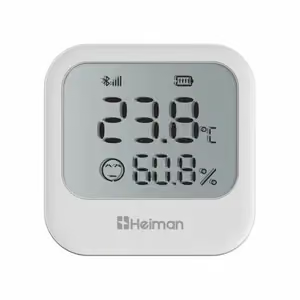
- Power supply
- DC3 V (Lithium Battery)
- Wireless protocol
- Zigbee
- Dimensions
- 60 × 60 × 14 mm
Price on request
3 products
Price on request
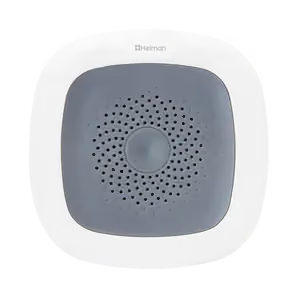
Price on request
Price on request
Delivery, installation, setup and warranty service from LAGI.
Describe the property and what needs protecting. We will send you the cost of equipment and installation.
Smart Temperature & Humidity Sensors are compact wireless IoT devices that monitor room microclimate in real time and send data to your smartphone, allowing you to create automatic climate control system, save energy, prevent mold and ensure comfortable environment in apartments, houses, offices, warehouses, greenhouses, hospitals in Tbilisi and throughout Georgia. These sensors measure temperature with accuracy ±0.3°C and humidity with accuracy ±3% RH, work via Wi-Fi (2.4GHz) or Zigbee 3.0 protocols, powered by batteries (CR2032, AAA, lifespan 1-2 years) or USB power, have LCD screen (optional), store history (day, week, month, year) and integrate with heating/AC systems for automatic control. LAGI offers full range of smart temperature and humidity sensors: Wi-Fi sensors (direct router connection, no hub needed), Zigbee sensors (low power consumption, mesh network, hub required), temperature range -20°C - +60°C, humidity range 0-99% RH, accuracy ±0.3°C / ±3% RH, LCD screen models (temperature + humidity + time), no screen models (compact, 30-40mm), battery power (1-2 years) or USB power (constant), wall mount or magnetic mount, integration with Alexa/Google Home/HomeKit. All sensors comply with CE standard.
Optimal temperature and humidity at home depends on room type and season: bedroom – temperature 16-19°C (optimal for sleep, cold temperature improves sleep quality), humidity 40-60% (healthy sleep, not too dry or humid). Living room – temperature 20-22°C (comfortable stay), humidity 40-60% (comfortable breathing). Children's room – temperature 18-22°C (optimal for children, not too cold or hot), humidity 40-60% (healthy sleep, not too dry). Bathroom – temperature 22-24°C (warm), humidity 50-70% (normal after shower, but >70% = mold risk). Kitchen – temperature 18-20°C (not too hot), humidity 40-60%. Basement/attic – temperature 10-15°C, humidity <60% (mold prevention). Winter – temperature 18-20°C (energy efficiency), humidity 30-50% (heating reduces humidity → use humidifier). Summer – temperature 22-25°C (comfortable), humidity 40-60%. Health: humidity <30% → too dry → dry skin, dry eyes, breathing problems → use humidifier. Humidity >70% → too humid → mold risk, allergies, breathing problems → use dehumidifier.
Temperature and humidity sensor helps save energy in several ways: 1) automatic heating control – traditional thermostat: always maintains fixed temperature (e.g. 22°C), heating works 24 hours, energy consumption 100%. Smart sensor + automation: "turn on heating if temperature <18°C and person in room (motion sensor)", "turn off heating if temperature >20°C or room empty", heating works only when needed → energy consumption 50-70% → savings 30-50%. 2) automatic AC control – traditional thermostat: always maintains fixed temperature (e.g. 22°C), AC works 24 hours, energy consumption 100%. Smart sensor + automation: "turn on AC if temperature >25°C and person in room", "turn off AC if temperature <23°C or room empty", AC works only when needed → energy consumption 50-70% → savings 30-50%. 3) zone control – heating/AC only in rooms where people are, not whole house → savings 40-60%. Typical savings: 1 sensor + automation → save 30-50% heating/AC energy → save 200-500 lari/year (depends on house size).
Wi-Fi and Zigbee temperature sensors are both wireless IoT devices, but there are important differences between them: Wi-Fi sensor (2.4GHz) – directly connects to Wi-Fi router, no additional hub/gateway needed, simple setup (connect via smartphone app), more power consumption (battery 6-12 months or USB power), ideal for small apartments (1-5 sensors), price 25-40 lari/sensor. Zigbee sensor (2.4GHz Zigbee 3.0) – connects to Zigbee hub/gateway (requires additional device 50-80 lari), low power consumption (battery 1-2 years or USB power), mesh network (sensors amplify each other's signal), more stable connection, ideal for large houses (10+ sensors), price 20-35 lari/sensor. Recommendation: small apartment (1-5 sensors) → Wi-Fi sensors (simple, no hub needed), large house (10+ sensors) → Zigbee sensors (better connection, long battery life, economy). If you already have Zigbee smart home system → definitely Zigbee sensors (integration). LCD screen: if need visual indication (temperature + humidity + time) → choose LCD screen model, if not needed → choose no screen model (more compact, cheaper).