Addressable or conventional fire alarm? How to choose for your building
How addressable and conventional fire alarms locate a fire, how the cabling, panels and maintenance differ, and which system suits your building.
5 min read
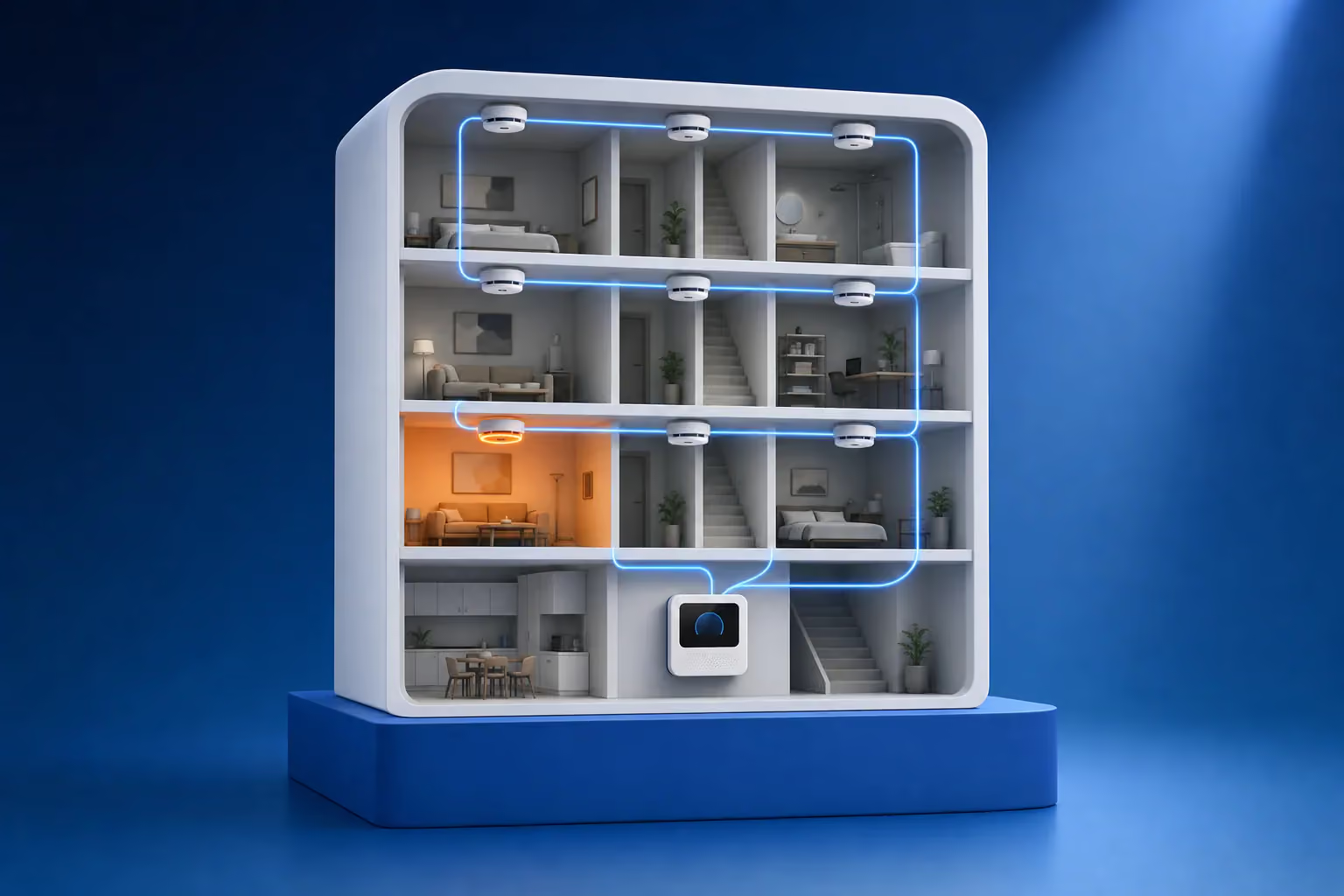
An addressable fire alarm shows on the panel the exact detector and room where a fire was detected. A conventional system shows only the zone, a group of detectors on one circuit, and someone has to walk every room in that zone to find the source. A small shop, café or office with a few rooms is usually fine with a conventional system. A building with dozens of rooms on several floors needs an addressable one.
How a conventional system works
Conventional detectors are wired onto zone circuits that run from the control panel through the premises. Several detectors share a circuit, and the panel only sees the state of the circuit as a whole: normal, fire, open circuit or short. If a zone covers five rooms, the panel reports a fire in that zone, and the room has to be found on the spot.
The system is simpler to set up, detectors and panels cost less, and the installer does not have to program each device. Its weak point shows up with false alarms and faults. The panel cannot tell you which detector is dusty or has been removed, so the only way to find it is to check them one by one.
How an addressable system works
In an addressable system each device has its own address on the loop, and the panel polls them in turn. In an alarm, the screen shows which detector triggered and where it is, for example "Floor 3, room 312". The loop is usually wired as a ring with short-circuit isolators. If the cable is cut or shorted somewhere, the system keeps working, and only the damaged section drops out.
Analogue addressable detectors report the actual smoke or heat level, and the panel itself decides when to raise the alarm. The panel compensates for dust in the chamber, warns in advance when a detector needs cleaning, and can raise a pre-alarm before the main alarm. Faults are visible device by device: a detector removed, dirty or disconnected.
Side by side
| Parameter | Conventional | Addressable |
|---|---|---|
| What the panel shows | The zone where one of the detectors triggered | The exact detector and room |
| Cabling | A separate circuit for each zone | One loop for many devices |
| Cable damage | The zone, or part of it, stops working | Isolators cut off only the damaged section |
| Finding a fault | Checking every detector in the zone | The panel shows the device |
| Equipment cost | Lower | Higher per device |
| Setup | Simple | Programming each address and the cause-and-effect rules |
| Where it fits | Shops, cafés, small offices, houses | Hotels, schools, clinics, office blocks, warehouses, multi-storey buildings |
When a conventional system is enough
If the premises are small and the whole zone can be walked in a minute, the exact detector address adds little. A conventional system suits a shop, a café, an office with a few rooms, a house or a small warehouse. Zones are drawn so each covers a clear part of the site: the sales floor, the stockroom, the back rooms. The equipment is in the conventional fire alarm section of our catalog.
When you need addressable
An addressable system pays its way where finding the fire quickly matters and there are dozens of rooms. That means hotels, schools, clinics, office blocks, apartment buildings and large warehouses. These sites also need the loop to survive cable damage and the panel to control other systems: an addressable panel shuts down ventilation, releases doors on escape routes and triggers voice evacuation floor by floor. Models are in the addressable fire alarm section.
For public and commercial buildings, the system type and detector layout are set by a design that follows the current fire safety rules. On such sites, the choice between addressable and conventional starts with the design.
Wireless fire alarms
Wireless detectors talk to the panel by radio. They are used where cable would spoil the interior or is not allowed: historic buildings, hotels with finished interiors, rooms that cannot close for works. Wireless systems are usually addressable. Detector batteries are replaced on the schedule the manufacturer sets, and the panel warns in advance when they run low. Options are in the wireless fire alarm section.
What every system consists of
- A control panel that receives signals and runs the warning devices.
- Smoke detectors for bedrooms, corridors, offices and warehouses.
- Heat detectors for kitchens, boiler rooms and places where smoke appears without a fire.
- Manual call points by the exits, so a person can raise the alarm.
- Sounders and beacons, and in large buildings voice evacuation.
- Battery backup in case of a power cut.
In a house or apartment where a professional system is not needed, standalone and smart smoke alarms are the first line of protection. Our article on smart home sensors that make a home safer covers them.
How we design and install fire alarms
A LAGI engineer surveys the building and works out the zones or addressable loops, the positions of detectors and sounders, and the links with ventilation, doors and the public address system. Site surveys in Tbilisi are free. We then carry out the fire alarm installation, program the panel and test every detector with test smoke or heat. To find out the cost for your building, send a quote request.
Frequently asked questions
What is an addressable fire alarm?
A system in which every detector has its own number on the loop. The panel polls the devices continuously and, in a fire, shows exactly which detector triggered and which room it is in. It also reports faults device by device, such as a dusty or removed detector, which makes maintenance easier.
Can addressable detectors connect to a conventional panel?
No. Addressable detectors use their panel's protocol and usually work only with the same manufacturer's equipment. The reverse is possible: conventional detectors can connect to an addressable panel through a zone module. This is how an old system is upgraded in stages.
Which fire alarm suits a small office or shop?
If the premises fit into one or two zones and can be walked in a minute, a conventional system is usually enough. It costs less and is simpler to set up. If the office spans several floors, has many rooms, or the fire alarm has to control doors and ventilation, choose addressable.
Does a house need a fire alarm?
Even where a professional system is not required, a house should have smoke alarms. A standalone battery alarm sounds loudly by itself when it detects smoke, and a smart one also sends a notification to your phone. Fit one in every bedroom, in the hallway and on every floor, and add a carbon monoxide alarm near a boiler or fireplace.