Barrier gate or turnstile, which to choose for your entrance
How an automatic barrier works, how to choose the boom and the way it opens, which types of turnstile exist and how both connect to access control.
6 min read
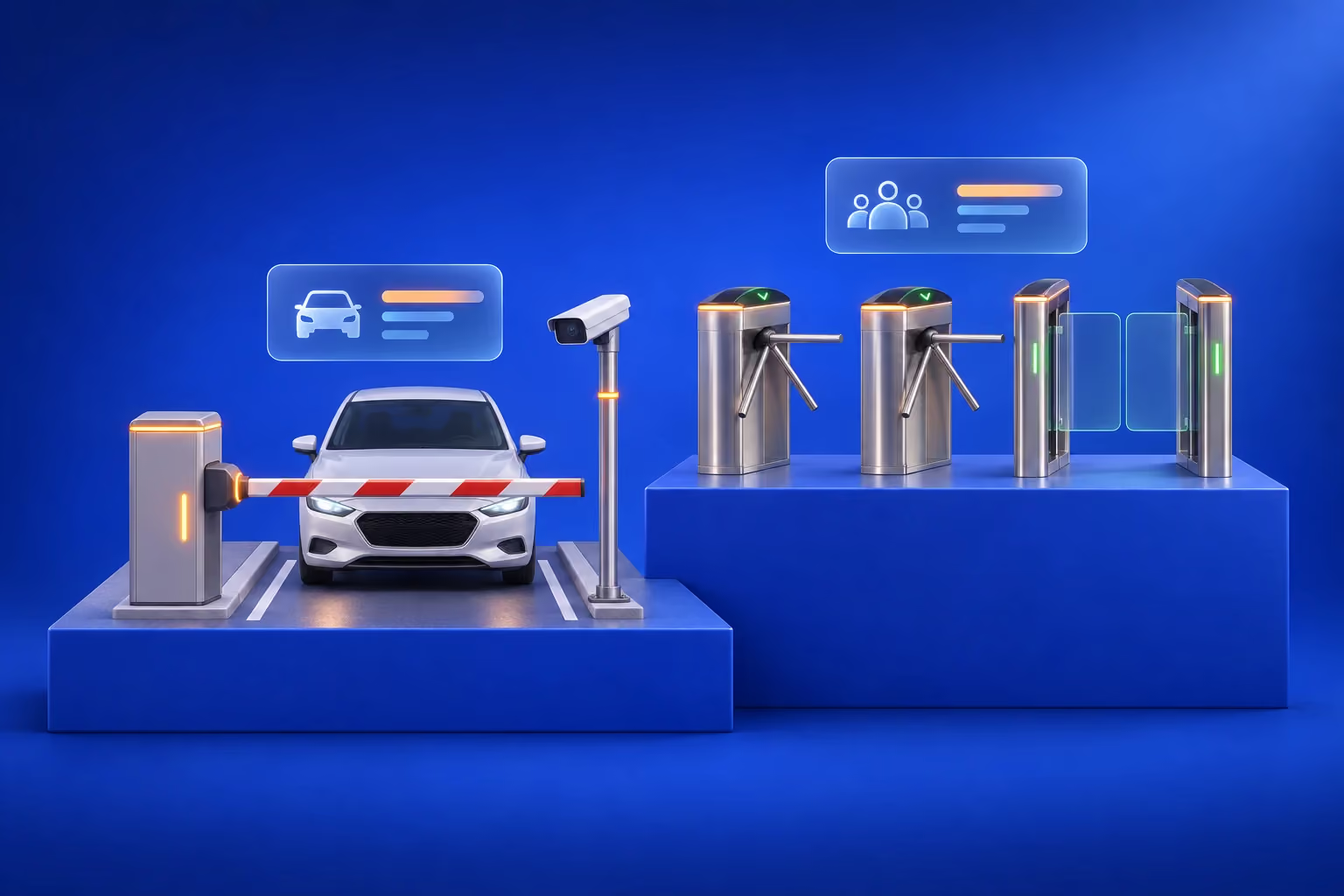
A barrier gate closes an entrance to cars and a turnstile controls an entrance for people: barriers go at the entrance to a yard, a car park or a residential complex, turnstiles at the reception of an office, a factory, a school or a gym. Many sites need both, and both run on the same access control system. Below we explain how an automatic barrier works, how to choose the boom and the way it opens, which types of turnstile exist and what to plan for during installation.
What a barrier gate is and how it works
An automatic barrier is a cabinet with an electric motor and a controller, plus a boom that rises and lowers on command. The command comes from a remote control, a tag reader, a number plate recognition camera or an access control controller. The motor is either a standard electromechanical drive or a servo motor: a servo raises the boom faster, stops it more smoothly and is built for entrances with heavy traffic.
An important part of any barrier is protection against hitting a car or a person. For this a radar, an induction loop in the tarmac or an infrared sensor is installed by the cabinet: while a car is under the boom, the boom will not come down. Servo models also have anti-crash protection: if the boom meets an obstacle, it rises again. In case of a power cut, the barrier has a manual release.
How to choose a barrier gate
- Boom length follows the width of the entrance. For a yard or car park 3–4.5 m is usually enough; a wide entrance gets a 6 m telescopic boom.
- Boom type. An underground car park with a low ceiling needs a folding boom, and a boom with a skirt also closes off the gap for pedestrians.
- Speed and service life. Entrances to residential complexes or retail car parks get a servo barrier: the boom opens in 0.3–3 s, and such models are rated for millions of cycles.
- Opening method depends on who drives in and how often.
Ways to open a barrier:
- a radio remote for a yard or a small car park where all drivers are known;
- a UHF tag on the windscreen, which the reader detects from several metres away, so the driver does not need to stop and lower the window;
- the number plate: a recognition camera checks it against the list of permitted cars and keeps a log of every entry and exit;
- a card, code or ticket through the access control system, with a ticket terminal for one-off visitors.
ZKTeco barriers with number plate recognition cameras, UHF readers, radars and ticket terminals are in our barrier gates and parking equipment section.
Types of turnstile
- Tripod turnstile: a cabinet with three arms that rotate for one passage. A compact option that is easy to maintain, for the entrance of an office, a factory or a school.
- Speed gate with flaps: glass or plastic wings open in front of a person and close behind them. It goes in the lobby of a business centre, where appearance and a big morning rush matter.
- Full-height turnstile: a rotating structure as tall as a person. It is installed outdoors on the perimeter of a factory, stadium or building site, where nobody should be able to climb over.
- A side gate next to the turnstile for pushchairs, trolleys and wheelchairs, and for evacuation.
Which turnstile is best depends on the site: how many people pass at peak time, whether it stands indoors or outdoors, how important it is that a second person cannot follow the first, and how it should look.
Barrier gate or turnstile
| Feature | Barrier gate | Turnstile |
|---|---|---|
| Who it lets through | Cars | People, one at a time |
| Where it goes | Entrances to yards, car parks and residential complexes | Reception, lobby, site entrance |
| How it opens | Remote, UHF tag, number plate, card or ticket | Card, fingerprint, face, code, QR code |
| Stopping tailgating | The boom lowers after each car | Lets exactly one person through |
| Installation needs | Concrete base, power cable, sometimes a cut for the loop | Level floor, cable under the floor or in trunking |
How barriers and turnstiles work with access control
Barriers and turnstiles are output devices, just like an electric lock on a door. The decision about who may pass is taken by the access control controller: it receives data from the card, fingerprint, face or number plate reader and gives the command to open. One system can hold a shared list of residents or staff with rights to drive in and walk through, and the log shows who passed or drove in and when. At a factory, the same turnstile log becomes the basis for time and attendance.
During a fire alarm a turnstile must free the passage, so it is connected to the fire alarm. Our article types of access control systems covers how these systems differ and how to choose one.
Barrier and turnstile installation by LAGI
A barrier needs a concrete base, a power cable and, if a loop detector is used, a cut in the tarmac. A turnstile is anchored to a level floor, with the cable run under the floor or in trunking. LAGI chooses barriers and turnstiles to suit the flow of cars and people, installs them, connects remotes, readers or cameras and sets up access rights as part of our access control installation service, in Tbilisi and across Georgia. How this works for a whole car park, with cameras and lighting, is shown in our solution barrier gates and security systems for car parks. Site surveys in Tbilisi are free, and you can describe your entrance or reception in a quote request.
Frequently asked questions
What is a barrier gate?
A barrier gate controls vehicle access: a cabinet with a motor and a boom that rises to let a car through and lowers behind it. An automatic barrier opens by remote, by a tag on the windscreen, by number plate or by card. It is installed at the entrance to a yard, a car park, a residential complex or a factory site.
What happens to a barrier in a power cut?
Without power, an automatic barrier cannot raise its boom on command, so it has a manual release: the boom is raised by hand with the key or lever supplied. If the entrance must keep working during power cuts, the cabinet and controller are connected to an uninterruptible power supply. How long it lasts depends on its capacity and the number of cycles.
Which turnstile is best for an office?
A small office or a factory entrance usually gets a tripod turnstile: it is compact, reliable and easy to maintain. The lobby of a business centre with a big morning rush gets speed gates with flaps, which are faster and look better. A side gate next to the turnstile is always needed for pushchairs, goods and evacuation.
Why does a barrier need a radar or a loop?
A radar or an induction loop detects a car under the boom and stops the boom coming down on it. Without one, the boom can hit a car that follows too closely or has stopped under the barrier. The loop is cut into the tarmac in front of the cabinet; the radar sits on the cabinet and needs no cut.