Electromagnetic or electromechanical lock, which to choose for your door
How electromagnetic and electromechanical locks work, what happens to them in a power cut, how they are wired and which one suits your door.
6 min read
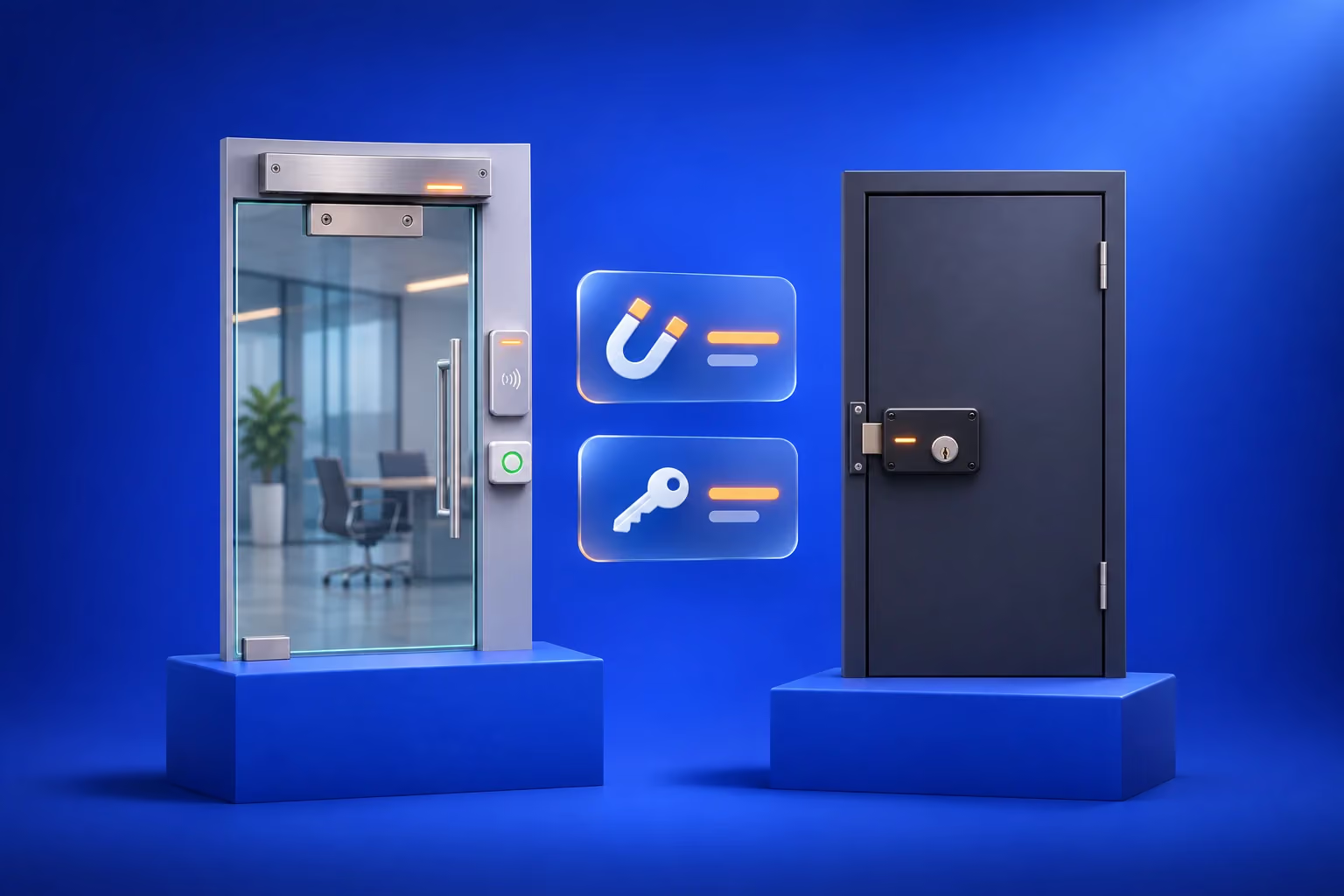
An electromagnetic lock holds the door shut while it has power and releases it when the power is removed, which is why it is used on office and communal entrance doors and on emergency exits. An electromechanical lock secures the door with a bolt or latch and stays locked without electricity, so it suits a garden gate, the front door of a house and rooms where keeping property safe matters more than a free exit. Below we explain how each lock works, how they differ in use, how they are wired and what to look at when choosing.
How an electromagnetic lock works
An electromagnetic lock has two parts: an electromagnet fixed to the door frame and a steel armature plate on the door itself. When voltage is applied to the magnet, usually 12 V, the plate is pulled against it and the door stays shut. To open the door, a controller, exit button or intercom cuts the power for a few seconds and the magnet lets go of the plate.
The key parameter is holding force, given in kilograms. For an interior door 180–280 kg is usually enough, while a metal front door gets a stronger lock. The magnet has no moving parts, so it is silent and hardly wears.
This lock has one important property: without power, the door is open. On an emergency exit that is an advantage, because nothing holds people back during a fire or a power cut. For security it is a drawback, so an electromagnetic lock is connected through a power supply with a backup battery that keeps the door locked during a power cut.
How an electromechanical lock works
In an electromechanical lock, mechanics hold the door: a bolt or latch, as in an ordinary lock. The electric signal only retracts the latch so the door can be opened. Many models work on a pulse: a short signal releases the mechanism, the door is opened, and when it closes the lock secures it again.
Most often this type stays locked when the power fails, and in that case it can be opened with a key. It suits a garden gate, a driveway gate, the front door of a private house and a storeroom: places where the door must not open by itself if the electricity goes. The drawbacks are the click when it operates and mechanical wear: a lock opened hundreds of times a day needs its mechanism adjusted over time.
There is also a third option, the electric strike, which replaces the ordinary strike plate in the frame while the mechanical lock on the door stays as it is. Electric strikes, brackets and mounting accessories are in our automatic door openers section, and the locks themselves in the electric locks section.
How they differ in use
| Feature | Electromagnetic | Electromechanical |
|---|---|---|
| Without power | Door is open | Door usually stays locked, opens with a key |
| Noise | Silent | Clicks when opening |
| Wear | Almost none, no moving parts | Mechanism wears with frequent use |
| Power | Constant while the door is locked | Only at the moment of opening |
| Fitting | On the frame, no cutting into the door | Surface-mounted or mortice, sometimes needs cutting in |
| Typical use | Offices, communal entrances, emergency exits, glass doors | Garden gates, driveway gates, front doors of houses, storerooms |
How to connect an electromagnetic lock
The wiring is almost always the same. The lock is powered by a 12 V power supply. Between the supply and the lock sits a relay that breaks the circuit on command: the output of an access controller, the intercom's relay or simply an exit button. An exit button goes on the inside next to the door so people can leave without a card, and on escape routes there is also an emergency break-glass button that cuts the lock's power mechanically, even if the controller has frozen.
- The cable runs to the magnet inside the frame or in trunking, and to the door through a flexible door loop.
- A protective diode or varistor goes across the magnet coil if the lock does not have one built in: it absorbs the voltage spike at switch-off that would otherwise damage the controller.
- A door that opens inwards needs an angle bracket, otherwise the magnet cannot sit opposite the plate.
An electromechanical lock is connected the same way, except that the relay closes the circuit for the moment of opening instead of breaking it. Before buying, check what signal your intercom or controller gives and which type of lock it is designed for.
How to choose a lock for your door
- Emergency exit or a shared office door: an electromagnetic lock with a break-glass button and a power supply with a backup battery.
- Glass door: an electromagnetic lock with a glass door bracket, since a lock cannot be cut into the glass.
- Outdoor garden gate or driveway gate: an outdoor-rated electromechanical lock, or a magnet designed for outdoor use.
- Front door of a private house: an electromechanical lock that stays locked in a power cut and opens with a key.
- Door with an old mechanical lock: an electric strike in the frame, if you would rather not replace the lock.
The lock is only one part of the system. How the door is opened, by card, code, fingerprint or phone, and how that ties in with records and an access log, is covered in our article types of access control systems.
Electric lock installation and repair
LAGI chooses a lock to suit the door and the way people use it, fits it with the reader, buttons and power supply as part of our access control installation service, and connects it to the intercom if you have one. If a lock no longer holds the door or will not open, an engineer finds the cause on site as part of our maintenance and repair service. Site surveys in Tbilisi are free, and you can describe the door and the job in a quote request.
Frequently asked questions
Does an electromagnetic lock open in a power cut?
Yes. Without power the magnet releases the armature plate and the door opens, which is exactly what an emergency exit needs. To keep the door locked during a power cut, the lock is connected to a power supply with a backup battery, sized by the lock's current and by how many hours the door must stay locked without mains power.
How do I connect an electromagnetic lock to an intercom?
The lock is powered by its own 12 V power supply, and the intercom breaks the circuit with its relay when you press the door release button on the monitor. Before connecting, check the intercom's manual to see whether its output can work with a magnetic lock and what current its relay can handle. An exit button goes on the inside next to the door.
What holding force should an electromagnetic lock have?
For a light interior or glass door, a 180–280 kg lock is usually enough. A metal front door, a communal entrance door or a gate that someone might try to force needs a stronger lock. The holding force is listed in the specifications of each model, and it only counts if the armature plate sits flat against the whole face of the magnet.
Which is more reliable, an electromagnetic or an electromechanical lock?
They are reliable in different ways. An electromagnetic lock hardly wears and suits doors that open all the time, but without power it releases the door. An electromechanical lock stays locked without electricity and opens with a key, but its mechanism wears. So the choice depends on the door: a magnet for an emergency exit, an electromechanical lock for a garden gate or the front door of a house.