Security cameras for a country house that stands empty for weeks
Why a house you only visit now and then needs cameras, where they go on the plot, and how to run CCTV without wired internet or reliable power.
5 min read
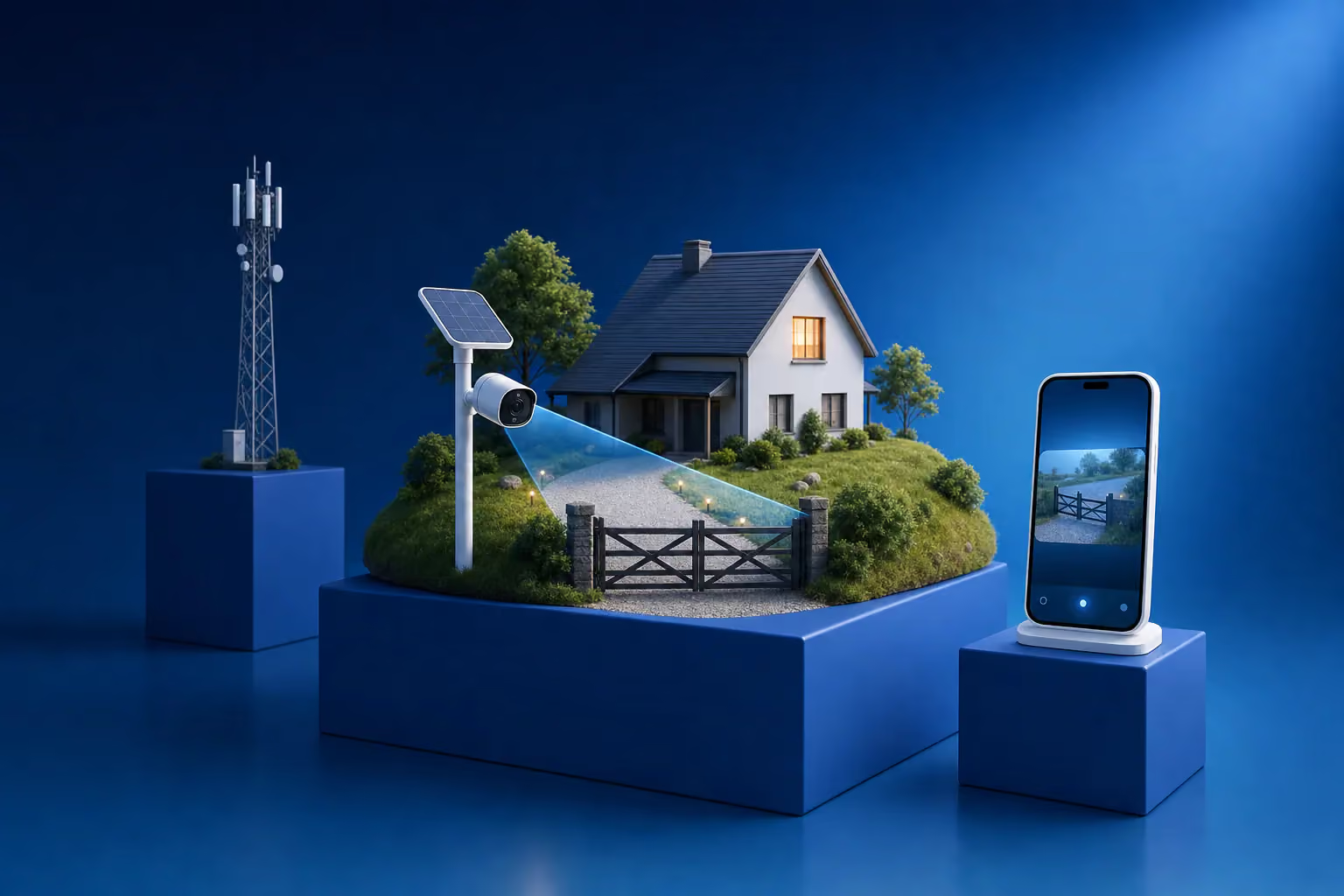
Security cameras for a country house solve a problem a city apartment does not have: the house stands empty for weeks, the neighbours are far away, and the owner only learns about a theft or a burst pipe on the next visit. Cameras with remote viewing show the plot on your phone at any moment, send an alert when someone approaches the gate, and keep recordings for the police and the insurer. The difficulties are particular too: country houses often have no wired internet, the power goes off, and the gate can be a hundred metres from the house.
What cameras give a house you visit now and then
- You open the app and see the gate, the yard and the front door wherever you are.
- A camera with analytics sends an alert when a person or a car crosses a line at the gate or fence. It ignores branches and shadows.
- The recording shows who left the plot, when, and with what. That helps with the police and the insurance company.
- You can see when builders, the gardener or whoever clears the snow arrived and left.
- A visible camera at the gate and a light that switches on with movement show that the plot is watched.
Where cameras go on the plot
| Spot | What should be visible | What to watch for |
|---|---|---|
| Driveway gates and garden gate | Faces and number plates | Narrow lens, illumination, out of reach |
| Front door | Who comes to the door | A camera under the porch roof, out of the rain |
| Yard and driveway | Movement on the plot, vehicles | Wide lens, line-crossing analytics |
| Garage, shed, sauna | Who goes near tools and machinery | An outdoor camera with infrared |
| Back of the plot | Someone climbing the fence | A camera along the fence with a line over its full length |
| Inside the house | The front door from inside | One camera on the door, recording only while you are away |
Our article how to choose home security cameras covers resolution, lenses and night vision for each spot.
If there is no wired internet
For several cameras, a 4G router with a SIM card works best. The cameras and the recorder connect to it like an ordinary home router. Recording goes to the recorder's disk in the house and uses no mobile data. Data is used only when you watch the cameras on your phone or alerts with snapshots arrive. If the signal on the plot is weak, an external antenna on the roof goes on the router.
For one distant spot, such as a gate a hundred metres from the house, a 4G camera with its own SIM card fits. If there is no signal at all, the cameras record to a recorder or a memory card, and you watch the footage when you arrive. There are no alerts in that case.
If the power goes off or cannot reach a spot
When the power goes off, the recorder, router and PoE switch shut down, and recording stops at the worst moment. That is why they are connected to a UPS. How many hours the system lasts depends on the battery capacity and the number of cameras, and it is worked out in advance.
For a spot no cable can reach, there are solar-powered cameras with a battery, usually with 4G. There is less sun in winter, so the panel and battery are sized with spare capacity.
Large plots and distant spots
A single PoE cable gives a camera both power and data, but the run is limited to 100 m. For distant gates, an intermediate switch goes in the garage or sauna, and between the house and a guest house a wireless bridge is sometimes easier. Our article what is PoE explains the details. Cable across the plot is laid underground in a protective duct, so spades and rodents cannot damage it.
Winter and bad weather
A camera on a country plot spends the whole winter unattended. Check the operating temperature range in the specification and a housing rating of at least IP66. Cameras with a heated housing cope better with frost and do not fog up. Snow on the hood and cobwebs on the lens spoil the picture, so open every camera and check the night image each time you visit.
Cameras, alarms and sensors together
A camera shows what happened, but it does not sound a siren. For a house that stands empty for weeks, cameras are paired with a burglar alarm with door and window contacts, a siren and GSM, which makes a noise the moment a door opens. Leak and temperature sensors warn of a burst pipe or heating that has failed. Our article on smart home sensors that make a home safer covers them.
How we install CCTV on a country plot
LAGI has been working since 1989. An engineer walks the plot with you, marks the camera positions, checks the mobile signal and decides where cable, a wireless bridge or a solar camera is needed. We then carry out the CCTV installation, connect the UPS and set up the app on your phones. Options for a house are on our private house security page. To find out the cost for your plot, send a quote request.
Frequently asked questions
Can I watch cameras at a country house without wired internet?
Yes, through a 4G router with a SIM card. The cameras and recorder connect to it, and you watch them in the app as you would at home. Recording goes to the recorder's disk and uses no mobile data. For a single distant spot, a 4G camera with its own SIM card works.
How much mobile data do the cameras use?
Recording to the recorder uses none. Data goes on viewing from your phone and on alerts. One camera on a low-resolution substream of about 1 Mbit/s uses roughly 450 MB per hour of viewing. If you check the cameras for a few minutes a day, an ordinary mobile plan is enough.
Do the cameras work in freezing weather?
Yes, if their operating temperature range suits the climate, which is listed in the specification. For cold sites, choose cameras with a heated housing and IP66 or IP67 protection. Solar camera batteries deliver less energy in frost, so they are chosen with spare capacity.
Which is better for an empty house, cameras or an alarm?
Both together. The alarm triggers as soon as a door or window opens, sounds the siren and calls you over GSM. The cameras show what happened and keep the recording. For a house nobody lives in full time, the pair covers both the break-in and working out what happened afterwards.